 Electrical
 Table of Contents
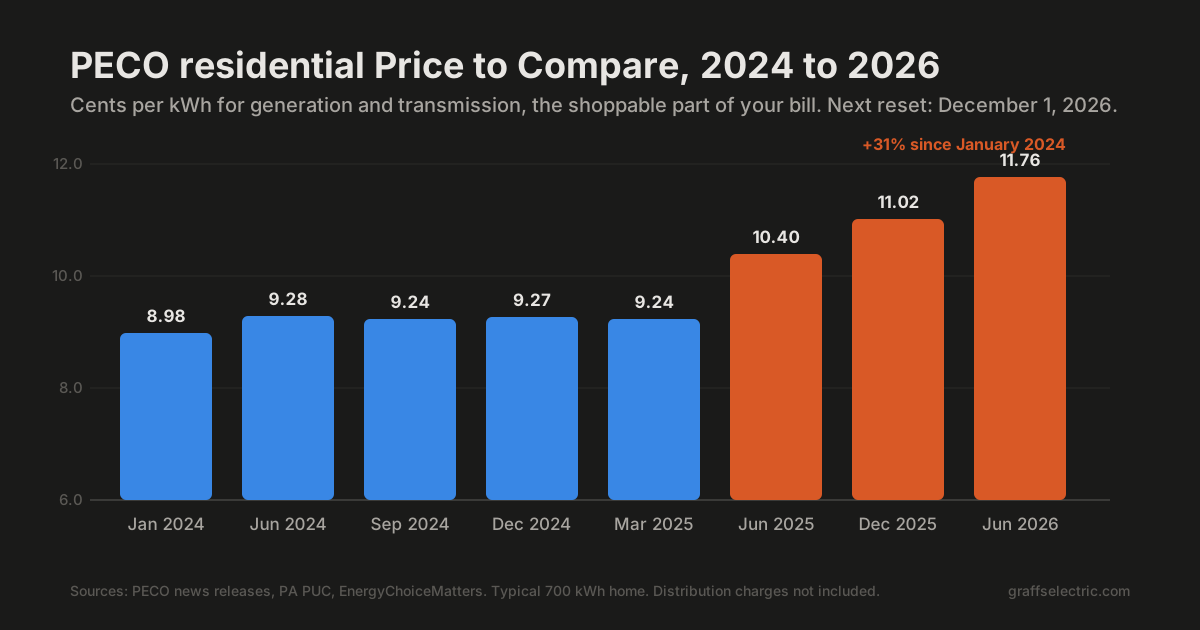
If your PECO bill this summer felt higher than the same months last year, it was not the heat, or not only the heat. The price PECO charges for the electricity itself, the “price to compare” on your bill, went to 11.76 cents per kilowatt-hour on June 1. Last summer it was 10.40. In January 2024 it was 8.98. That is a 13 percent jump year over year and a 31 percent climb in two and a half years, before a single kilowatt-hour of usage changes.
We get asked about this on service calls constantly, usually phrased as “is there anything you can do about it.” The honest answer has two halves. Most of the increase is coming from the regional wholesale market, and no electrician can touch that. But a surprising amount of what you pay is driven by a handful of specific loads in your house, and those we can do something about. This post covers both halves, with the numbers.
What Is Actually on a PECO Bill
Your bill has two big pieces. Distribution is PECO’s own charge for the poles, wires, transformers, and crews that get power to your meter. For a standard residential customer it is a fixed $11.29 a month plus about 10.2 cents per kilowatt-hour, set by the Public Utility Commission, and you cannot shop it. Generation and transmission is the electricity itself plus the cost of moving it across the regional grid. That is the price to compare, currently 11.76 cents, and it is the part you are allowed to buy from a competing supplier.
Add them up and a typical Bucks County home pays somewhere around 22 cents per kilowatt-hour all in. The statewide average for June was 21.73 cents, up from 19.69 a year earlier, according to the federal Energy Information Administration.
Why the Generation Price Keeps Climbing
PECO does not make electricity. It buys it on your behalf through the regional grid operator, PJM, which runs a market covering 13 states. Once a year PJM holds a capacity auction to lock in enough power plants for a delivery year three years out, and the results of that auction flow straight into the price to compare.
The last three auctions all cleared at the maximum price the federal regulator allows: $329 per megawatt-day in July 2025, $333 in December 2025, and $325 on July 14 of this year. The most recent one came up 6,831 megawatts short of the reliability target and added only 525 megawatts of new generation. In PJM’s own words, “demand for electricity continues to grow faster than electricity supply.” The bill for that auction alone is about $16.4 billion across the region.
The demand is not coming from homes. PJM has said that nearly all of the peak-load growth in its forecasts is data centers, and the market’s independent monitor calculated that data center load accounted for 9 percent of all wholesale power costs in the first seven months of 2026 and $29.4 billion of capacity charges across the last four auctions. When the price to compare resets on December 1, the July auction is already baked into it. We are not going to guess the number, but the direction is not a mystery.
What Harrisburg Did This Spring, and What It Did Not Do
Two things happened that you probably saw in the news, and they get conflated.
The PECO rate increase was withdrawn. On March 30, PECO asked the PUC for a $429 million distribution increase, about $20 a month for a typical home starting in 2027, plus $81 million on the gas side. Governor Shapiro called it “pure greed,” Bucks County legislators from both parties told PECO to pull it, and on April 16 PECO withdrew the whole filing. PECO’s CEO said “keeping bills as low as possible must be the top priority right now,” and was replaced within the week. That is real money you will not pay in 2027. But notice which half of the bill it was: distribution. It did nothing to the generation price, which is the half that has been climbing.
The data center executive order. On August 18 the governor signed Executive Order 2026-05. In plain terms: data centers over 25 megawatts have to sign a consent order to get fast permit review; utilities are to curtail data centers before homes in a grid emergency unless the data center brought its own new generation; data centers must pay their own grid-upgrade and backstop costs with no pass-through to other customers; and state agencies can no longer sign non-disclosure agreements with them. It is a reasonable set of protections. It also does not lower anyone’s December bill, because the capacity costs through 2029 are already set.
So: the distribution increase is off the table, the generation price is still going up, and the fix for the generation price is a multi-year grid problem that no one in Harrisburg or at PECO can solve by winter.
Should You Shop for a Supplier Right Now?
You can, at the PUC’s site papowerswitch.com, and every few months a local news segment tells you to. Here is what the offers actually looked like on August 30. There were 131 offers from 42 suppliers. The single lowest fixed rate was 10.09 cents, on a three-month contract, which means it expires in December and rolls you onto whatever that supplier feels like charging. Twelve-month fixed offers with no monthly fee were mostly at or above the 11.76 cent price to compare. The offers that beat it on a 12-month term did it by adding a monthly fee of around $15, which erases the savings for a typical home.
Our rule, and it is the PUC’s rule too: only consider a fixed rate, only for a term you will remember to renew, only with no cancellation fee, and read the renewal notice when it comes 45 to 60 days before the end, because the default after expiration is a variable rate. If you cannot find a 12-month, no-fee, fixed offer below the price to compare, and right now you mostly cannot, stay on PECO default service and put the effort into the other half of the problem instead.
Where the Kilowatt-Hours Actually Go
A typical Pennsylvania home used about 817 kilowatt-hours a month in 2024. PECO’s own “typical customer” is 700. The bill is that number times roughly 22 cents. So the question is what is in the 700 to 800, and the answer surprises people:
- An electric vehicle driven 1,000 miles a month adds about 270 kilowatt-hours, or roughly $60 at all-in rates. Cheaper than gas, but it is a third of a typical home’s entire usage.
- A standard electric water heater in a family of four uses about 310 kilowatt-hours a month more than a heat pump water heater doing the same job. ENERGY STAR puts the difference at $550 a year.
- A 1,500 watt space heater running eight hours a day is 360 kilowatt-hours a month. That single plug-in heater can cost more than $75 a month and is the most common “why did my January bill double” answer we give.
- A single-speed pool pump running all season uses up to 70 percent more energy than a variable-speed pump moving the same water.
- A refrigerator older than 15 years costs about $95 a year more to run than a current model, and the spare one in the garage is usually the oldest appliance in the house.
- Always-on devices, the chargers, set-top boxes, printers, and smart speakers that never actually turn off, run 5 to 10 percent of a typical home’s electricity according to Lawrence Berkeley National Lab, and one study found closer to 20 percent.
Air conditioning is still the biggest single line item in summer, about a fifth of annual electricity use nationally, but it is also the one everyone already knows about.
Five Electrical Fixes That Measurably Lower the Bill
This is what we actually install, in the order we would do it in our own houses.
1. A whole-home energy monitor, first, before anything else. A monitor like the Emporia Vue 3 ($100 to $200 depending on how many circuits you track) clamps onto your panel and tells you, circuit by circuit, where the power is going. It is a 45-minute install for us, and it ends the guessing. About half the time it points at something nobody suspected: a well pump short-cycling, a dehumidifier running 24 hours a day, an attic fan with a stuck thermostat, a second fridge. You cannot fix what you cannot see, and the monitor pays for itself the first time it finds one of those.
2. A smart thermostat, properly wired, plus a heat pump or AC tune-up. ENERGY STAR only certifies thermostats that prove at least 8 percent heating and 10 percent cooling savings in the field. PECO’s own summer guidance says a serviced AC system uses 5 to 15 percent less. The wiring matters more than people think: a lot of Bucks County homes have no common wire at the thermostat, and the workaround adapters are where the “my smart thermostat keeps rebooting” calls come from. We run the wire.
3. A heat pump water heater on a new 240-volt circuit. For a family of four this is the single largest kilowatt-hour cut available in most houses, about $550 a year against a standard electric tank, with a payback under three years. It needs a dedicated 240-volt circuit, a condensate drain, and enough air volume in the room, which is why it is an electrician-and-plumber job rather than a box-store swap. PECO’s Act 129 rebate program started a new phase on June 1; the heat pump water heater amount for this phase was not published as of this writing, so call PECO Smart Ideas before you buy rather than counting on a number from last year.
4. A variable-speed pool pump circuit, and a timer on everything outside. The pump savings are up to 70 percent on the largest summer load after the AC. While we are out there, the pond pump, landscape lighting, and the garage fridge all get timers or smart plugs so they run when you want them to and not when you forgot about them.
5. Move the big loads into PECO’s cheap hours. PECO offers a whole-house time-of-use rate. On-peak is 2 PM to 6 PM on weekdays; super off-peak is midnight to 6 AM every day; everything else is off-peak. If you own an EV, a heat pump water heater, or a pool pump, a scheduled charger and a couple of timers can push most of that usage into the midnight-to-six window. We install load-managed EV chargers that do this automatically and also avoid tripping a service upgrade, which brings us to the last point. The rate only helps if you can actually shift; a home that runs the AC hard from 2 to 6 will lose money on it.
And the boring one: if you still have incandescent or halogen bulbs anywhere, recessed cans and outdoor fixtures especially, LED replacements use at least 75 percent less energy and last up to 25 times longer. It is the highest-return change in the house and the only one that needs no electrician at all.
If This Turns Into a Panel Upgrade
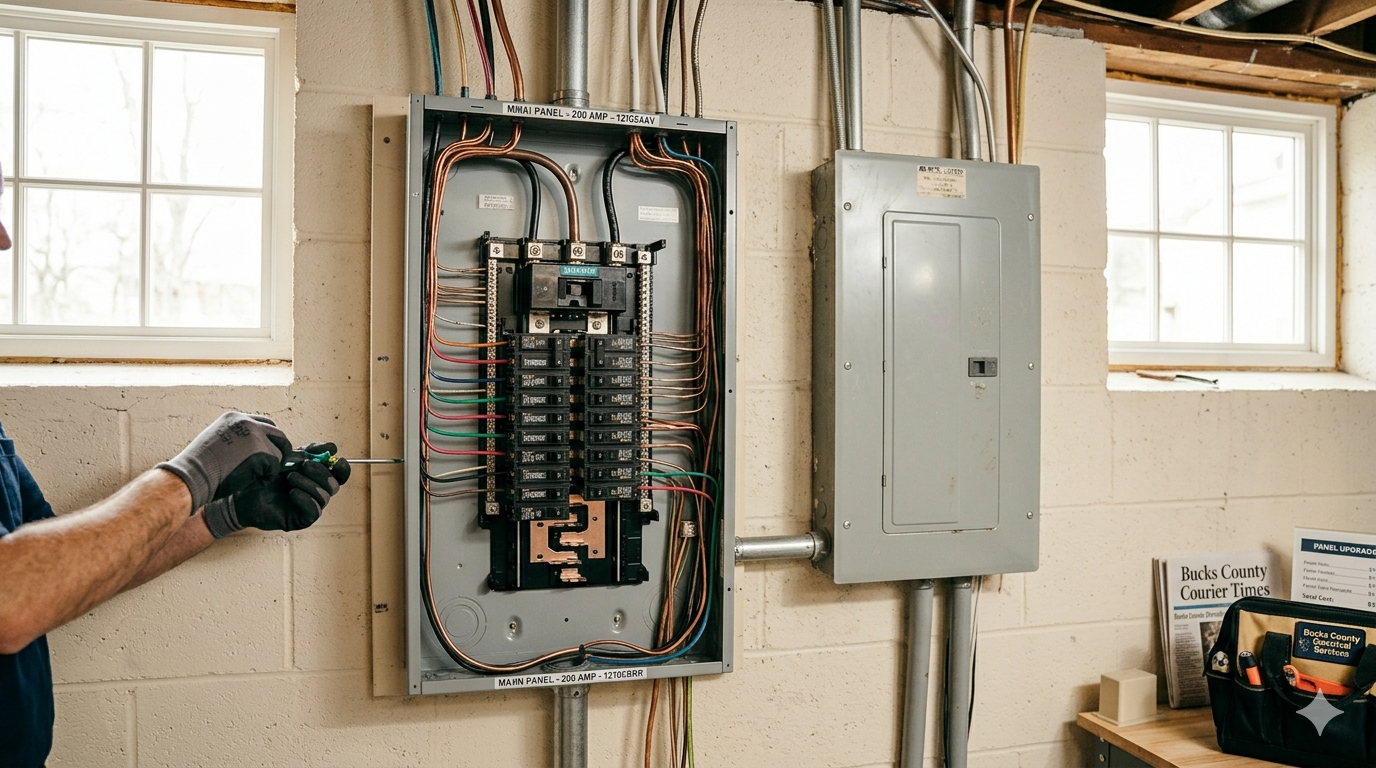
Two of the five fixes above add a 240-volt circuit, and a lot of the houses we work in, particularly the 100-amp services in Levittown, Warminster, and the older parts of Doylestown, do not have the room. Three things to know before you go down that road:
- Our free residential load calculator will tell you in five minutes whether your existing service can take a water heater, an EV charger, or both. Often it can, especially with a load-managed charger, and you save the upgrade entirely.
- If you do need a service upgrade, the National Electrical Code now requires a whole-home surge protective device on every replaced service (NEC 230.67). That is a good thing: it protects the heat pump, the water heater, and the charger electronics you just bought, and we covered why in our whole-home surge protection guide.
- PECO schedules service upgrades through its Service Installation and Upgrades Portal after the municipal inspection is approved, and the lead time varies. We handle that paperwork, but plan for weeks, not days. Current pricing is in our panel upgrade cost guide.
One More Reason to Look at Your Panel This Fall
July was a reminder that the bill is not the only electrical problem this year. The Fourth of July storms plus PECO’s first-ever union strike left more than 18,000 homes dark on July 5 and 700 in Bucks County still out on the evening of July 6. A week later, microbursts knocked out 34,000 customers around Philadelphia. PECO hit an all-time summer peak of 8,438 megawatts on July 2. The grid is being asked to do more than it was built for, and the long-range forecast for this winter is a strong El Nino, which in our area tends to mean ice and wind rather than deep cold.
If you have been thinking about backup power, our whole-house generator vs. portable comparison is the place to start, and the fall is when the install calendar fills.
The Short Version
- The generation price went up 13 percent this summer and resets again December 1. That part is PJM’s problem, not yours to fix.
- The PECO distribution increase for 2027 was withdrawn in April. That is settled.
- Supplier shopping is not beating 11.76 cents on honest 12-month terms right now. Check again in December.
- The loads that actually move a bill are the water heater, the EV, space heaters, the pool pump, the old fridge, and the always-on stuff. A circuit-level monitor finds yours in a week.
- The fixes with proven numbers are a heat pump water heater, a smart thermostat, a variable-speed pool pump, load scheduling on the time-of-use rate, and LEDs. Together they can take a few hundred kilowatt-hours a month off a typical home, which at 22 cents is the difference people are looking for.
If you want the monitor installed and a walkthrough of where your house is spending, that is a single visit. Members of our Electric Care plan get the panel check and the walkthrough as part of the annual inspection. Either way, reach out and we will get you on the schedule before the December reset.
Sponsored
Need a Licensed Electrician?
Serving Bucks & Montgomery County. Free estimates on all projects.
Get Your Free EstimateNeed Help With This?
Graff's Electric & IT Solutions is here to help with all your electrical and technology needs in Bucks & Montgomery County.