 Electrical
 Table of Contents
If you’ve got power strips behind your TV with little surge-protection lights on them, here’s the bad news: those strips don’t catch the surges that actually do damage. The big surges - the ones that come in from the utility line during storms or when transformers blip - bypass your power strips and hit everything plugged in to your house at once. The fridge, the well pump, the HVAC condenser, the garage door opener, the smart thermostats. Anything with a circuit board.
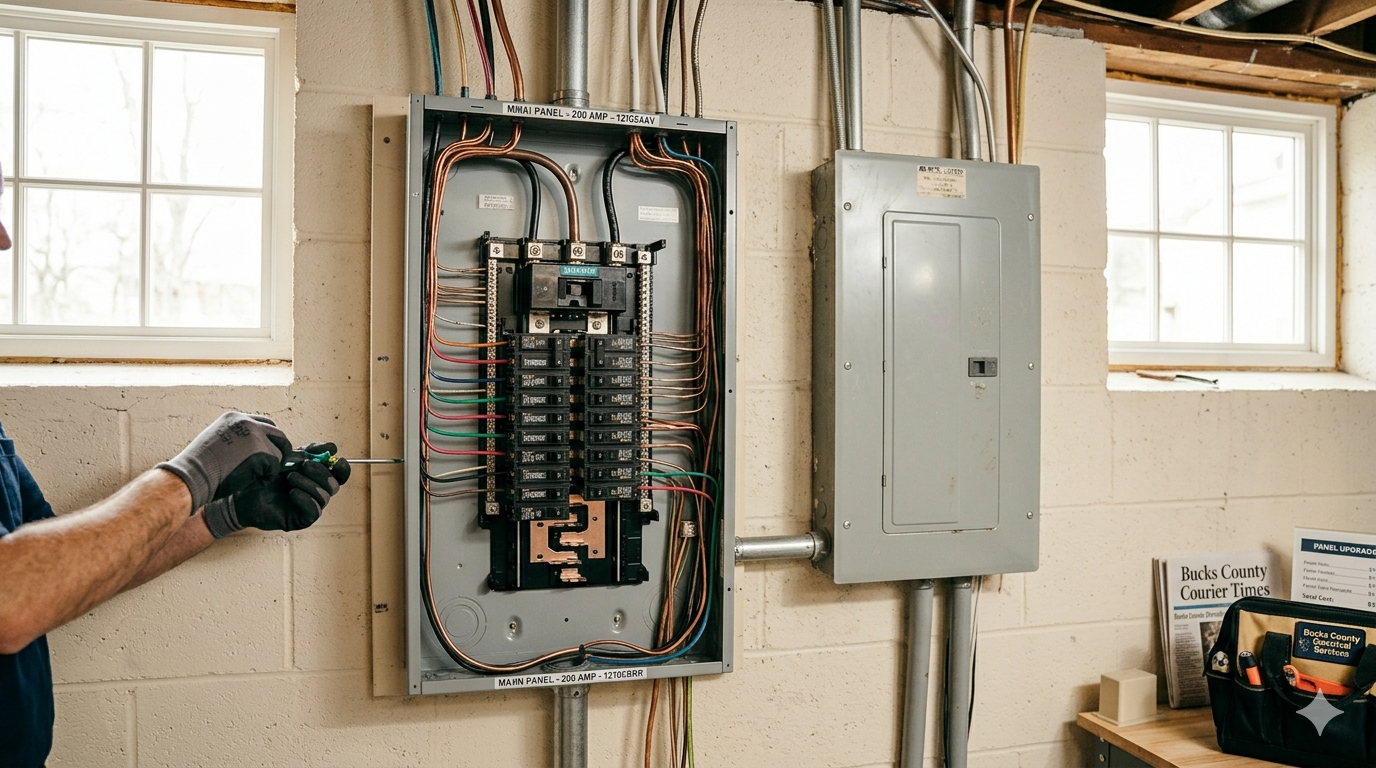
The fix is a whole-home surge protector mounted at your main panel. It’s a small device that sits inside (or right next to) your breaker box and clamps voltage spikes before they make it onto your branch circuits. After hundreds of installs across Doylestown, Newtown, Yardley, and out to Quakertown, this is the single cheapest add-on we recommend - and the one most homes still don’t have.
What a Whole-Home Surge Protector Actually Does
A standard plug-in surge strip handles small, gradual surges that build up on a single circuit - usually less than 600 joules of capacity. Useful, but limited.
A whole-home unit mounts at your service entrance and is rated for tens of thousands of amps of surge current. When a real surge comes through - say, a nearby lightning hit on the PECO line, or a downed wire that briefly arcs - the unit shunts that energy to ground before it can travel down the bus bars and into your circuits.
The big difference: a whole-home protector defends every outlet, every appliance, and every hardwired device in your house at the same time. Power strips can’t.
What Actually Causes the Surges
People assume surges only happen during thunderstorms. They don’t. The most common sources we see:
- Utility-side switching events. PECO performs reclosing operations during outages - a brief restore that can ride a surge in. Happens dozens of times a year.
- Transformer issues. Aging pole-top transformers occasionally surge when they fail.
- Appliance kickback. Big inductive loads - well pumps, AC compressors, dryers - generate surges back into your panel every time they cycle off. These are the slow killers.
- Lightning. Doesn’t have to be a direct hit. Strikes within a quarter mile can induce surges through your service drop.
Your washer’s control board doesn’t fail because of one big event. It fails because of years of small surges every time the well pump kicks off.
What’s the Cost?
For a typical Bucks County panel, a quality whole-home surge protector installed runs $275 to $425. That includes:
- The unit itself (Eaton, Siemens, Square D, or Leviton - all comparable at this tier)
- A double-pole breaker if your panel needs one to feed it
- About 30 minutes of labor
- Permit if your jurisdiction requires one (most don’t for this work)
If we’re already in your panel for another job - a panel upgrade, a circuit add, an EV charger install - adding a surge protector is usually closer to $200 because the labor is folded in.
Is It Required by Code?
Since the 2020 NEC, surge protection is required at the service equipment of all new dwelling units and any panel that’s being replaced. Pennsylvania adopted the 2023 NEC in early 2024, so any new home or panel upgrade in Bucks County now needs one to pass inspection.
If your panel was installed before 2020, you’re not required to retrofit - but you’re also not protected.
When It Pays for Itself
A new HVAC control board is $400 to $900. A modern fridge with a fried inverter is $1,500+. Replacing a smart thermostat is $200. A typical insurance deductible is $1,000.
A $300 surge protector pays for itself the first time it catches a surge that would have killed any one of those things. We see one or two replacements a month from surge damage in homes that didn’t have whole-home protection. None from homes that did.
The Bottom Line
If your panel was installed before 2020, ask us next time we’re out for anything - even a simple service call. Adding a whole-home surge protector takes 30 minutes and protects every appliance you own for the next 10–15 years. It’s the most boring, most underrated, most cost-effective electrical upgrade we sell.
Sponsored
Need a Licensed Electrician?
Serving Bucks & Montgomery County. Free estimates on all projects.
Get Your Free EstimateNeed Help With This?
Graff's Electric & IT Solutions is here to help with all your electrical and technology needs in Bucks & Montgomery County.