 Electrical
 Table of Contents
Older homes have character, craftsmanship, and history that newer construction rarely matches. They also frequently have electrical systems that have not kept pace with decades of updated safety codes, added loads, and evolving technology. When our electricians work on homes in Bucks County and Montgomery County built before 1980 - sometimes even before 2000 - we find the same electrical code violations on job after job. Some of these are nuisances. Some are genuine fire and shock hazards. All of them need to be addressed.
This is not a scare piece. Most older homes are perfectly livable with their existing wiring. But knowing what to look for helps you understand what questions to ask and how to prioritize repairs. Here are the five electrical code violations we see most often in the older homes we service throughout the region.
1. Federal Pacific and Zinsco Electrical Panels
This is the single most serious electrical code issue we find in older homes, and it shows up regularly in homes throughout Doylestown, Warminster, and surrounding communities built between the 1950s and 1980s.
Federal Pacific Electric (FPE) Stab-Lok panels and Zinsco panels were installed in hundreds of thousands of homes across the country during that era. Both have been extensively documented as problematic. The core issue: the breakers in these panels frequently fail to trip when they are supposed to. A breaker’s job is to interrupt the circuit when the current exceeds a safe level - protecting wires and preventing fires. When breakers fail to trip, the wires overheat. Overheated wires inside walls are a primary cause of residential electrical fires.
FPE Stab-Lok panels and Zinsco panels are not code-compliant for new installations, and many insurance companies will not cover homes that still have them - or will only cover them at elevated premiums. If you have one of these panels, replacement is not optional from a safety standpoint, even if the system appears to be functioning normally.
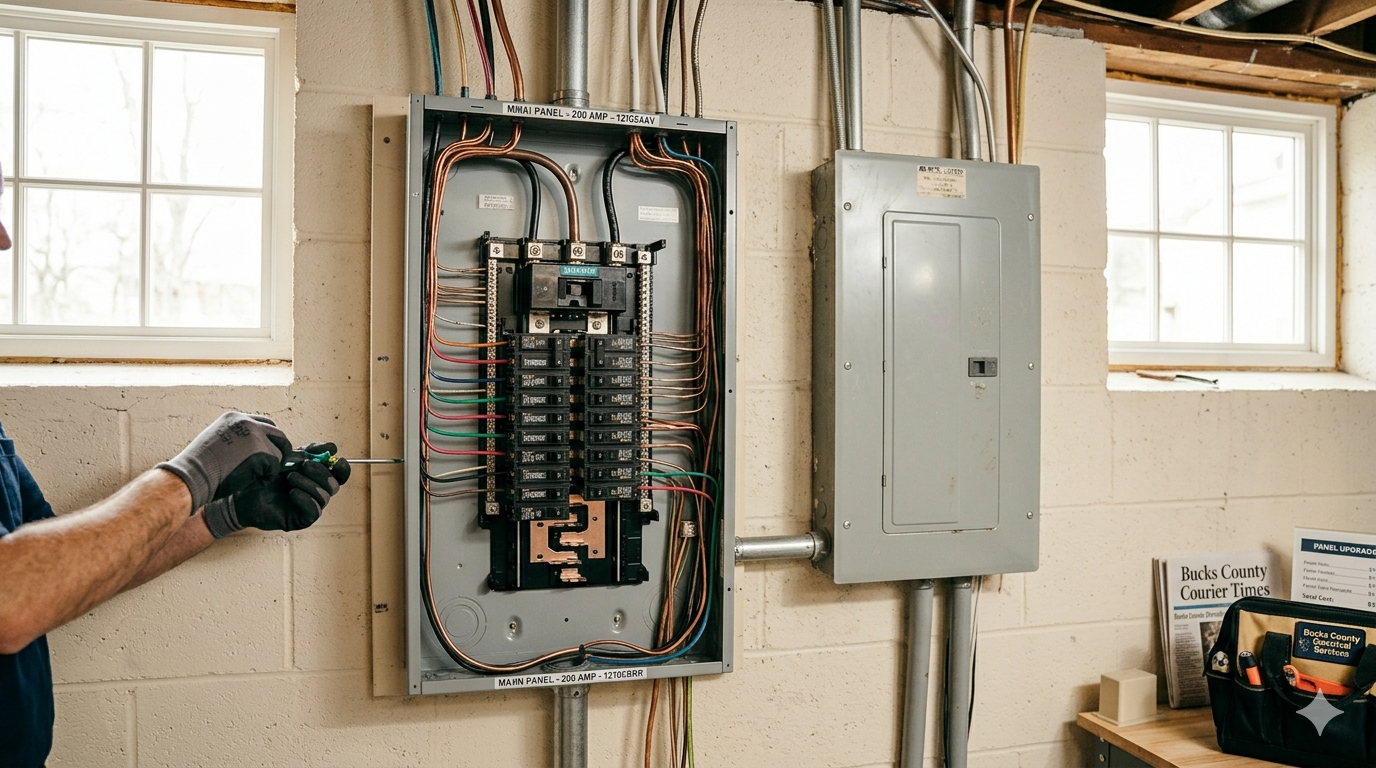
How to tell: Look inside your electrical panel. FPE panels say “Federal Pacific” or “Stab-Lok” on the breakers. Zinsco panels often have colorful breakers and a distinctive look. If you are not sure what you have, an electrician can identify it quickly.
2. Aluminum Wiring on Branch Circuits
In the late 1960s and 1970s, when copper prices spiked dramatically, many builders switched to aluminum wiring for the branch circuits inside homes - the wiring that runs from the panel to outlets, switches, and fixtures. Aluminum was cheaper and worked on paper, but it behaved differently than copper in ways that created serious problems over time.
Aluminum expands and contracts more than copper as it heats and cools. Over years of use, this movement causes connections at outlets, switches, and fixtures to loosen. Loose connections arc. Arcing causes fires. Aluminum also oxidizes differently than copper, and the oxide layer increases electrical resistance at connection points, generating heat.
Homes in Montgomery County and Bucks County with aluminum branch circuit wiring are not automatically dangerous, but they require specific attention. The NEC-approved remediation for aluminum wiring is pigtailing - connecting a short length of copper wire to the aluminum using a specifically rated connector (CO/ALR rated), so that outlets and switches can be made with the safer copper. This approach, done properly throughout the home, significantly reduces the risk.
Full rewiring is more comprehensive but also significantly more costly. Your electrician can help you assess the condition of the existing aluminum connections and determine the right approach for your home.
Signs to look for: If your home was built between 1965 and 1975, have a licensed electrician inspect for aluminum branch circuit wiring. It may be marked “AL” on the wire jacket if accessible.
3. Ungrounded Outlets (Two-Prong Receptacles)
Walk through a home built before 1960, and you are likely to encounter two-prong outlets throughout the house. Those two-slot outlets have no ground wire. Grounding is the third prong on a modern outlet - the round one below the two vertical slots - and it serves as a critical safety path that directs fault current away from people and equipment in the event of a wiring failure.
Ungrounded outlets are a code violation in any new or updated installation. They are also a practical problem for modern electronics: computers, televisions, and audio equipment all want a grounded outlet for protection and proper function. Three-to-two prong adapters (the “cheater plugs” that let you use a three-prong plug in a two-prong outlet) provide no grounding - they simply defeat the safety feature.
The correct fix depends on the wiring throughout the home. If grounded wiring already exists but the outlets were never updated, replacing the receptacles is straightforward. If the wiring itself lacks a ground conductor - common in homes with older two-wire knob-and-tube or early Romex - there are two code-approved options: run new grounded circuits to those locations, or install GFCI outlets and mark them “No Equipment Ground.” GFCI protection does not provide true grounding but does provide shock protection, which the NEC accepts as a code-compliant alternative in certain circumstances.
On almost every job we do in older homes throughout Horsham, Hatfield, and Lansdale, updating ungrounded outlets is on the punch list.
4. Knob-and-Tube Wiring
Knob-and-tube (K&T) is the wiring system used in homes built roughly before 1940, though some installations continued into the 1950s. It consists of separate insulated wires run through ceramic knobs and tubes, without any protective sheathing or ground wire. In its original form, installed properly in a home with no added loads, knob-and-tube wiring is not inherently dangerous - it was designed for the electrical demands of its era.
The problem is that very few homes with remaining knob-and-tube wiring are still in their original condition. Over the decades, homeowners and handymen added circuits, extended runs, spliced in junction boxes, and stapled additional wire through attic insulation that was blown in over the top of the K&T conductors. Insulation over knob-and-tube wiring is a fire hazard because the system was designed to radiate heat through open air - covering it traps that heat.
Knob-and-tube wiring is not code-compliant for new construction and is increasingly difficult to insure. Many insurance carriers will not issue or renew a policy on a home with active knob-and-tube wiring. In Bucks County and Montgomery County, where older housing stock is plentiful, this comes up on home sales regularly - buyers discover active K&T during inspection and face the question of whether to renegotiate or walk away.
Remediation typically means identifying how much of the wiring is still active, determining which circuits can be cost-effectively replaced or updated, and working through the home systematically. A licensed electrician experienced with older homes can map out a realistic approach.
5. Missing or Incorrect AFCI and GFCI Protection
Current editions of the National Electrical Code require Arc Fault Circuit Interrupter (AFCI) protection in bedrooms, living rooms, kitchens, and most other areas of a dwelling. They also require Ground Fault Circuit Interrupter (GFCI) protection in bathrooms, kitchens, garages, basements, outdoor locations, and near any water source. Homes that were wired under older code editions and never updated are frequently missing this protection entirely.
AFCI breakers detect the specific electrical signature of an arc fault - the kind of dangerous sparking that occurs when wiring is damaged, pinched, or has a loose connection inside a wall. Standard circuit breakers cannot detect this. Arc faults cause thousands of house fires every year. AFCI protection is a meaningful safety upgrade that was simply not available when most older homes were built.
GFCI protection detects ground fault current and cuts power in milliseconds - fast enough to prevent electrocution. The requirements for where GFCIs must be installed have expanded significantly over the decades, and a home wired in the 1970s or 1980s may have GFCIs only in a bathroom or two, while the current code requires them in many additional locations.
Upgrading to AFCI breakers is a panel-level change. Adding GFCI outlets or GFCI breakers can often be done incrementally, room by room. Both are commonly addressed during renovations, home sales, or as standalone safety upgrades. Local electrical inspectors in municipalities across Bucks County and Montgomery County pay close attention to AFCI and GFCI compliance during permit inspections on renovation projects.
FAQ
Q: Do I have to bring my entire house up to current electrical code? A: Not necessarily. The NEC generally does not require retroactive compliance - meaning you are not required to update your entire home just because you own it. However, when you do permitted electrical work, the areas of the home covered by the permit must meet current code. And for issues like FPE panels, aluminum wiring, and knob-and-tube, the practical reality is that insurance, home sales, and safety concerns make remediation the right call regardless of code requirements.
Q: How do I know if my home has any of these issues? A: A licensed electrician can perform an electrical safety inspection and walk through the home to identify these and other issues. We offer thorough inspections for homeowners throughout Bucks County and Montgomery County who want a clear picture of their electrical system’s condition.
Q: Is knob-and-tube wiring automatically a dealbreaker when selling a home? A: It can complicate a sale significantly, particularly if active K&T circuits are present and the buyer’s lender requires the home to be insurable. In many cases, sellers in Doylestown, Chalfont, Newtown, and similar markets address the issue before listing to avoid delays or price reductions at closing.
Q: What is the first thing I should do if I suspect electrical problems in my older home? A: Call a licensed electrician for an inspection before anything else. Do not attempt to open electrical panels or inspect wiring yourself. If you notice signs of trouble - frequently tripping breakers, flickering lights, burning smells, or discolored outlets - call immediately. These are warning signs that should not be ignored.
If you own an older home in Bucks County or Montgomery County and have questions about your electrical system’s safety, the best next step is a professional inspection. Call Graff’s Electric & IT Solutions at (215) 974-0720 or visit graffselectric.com to schedule service. Our licensed electricians work throughout Warminster, Doylestown, Lansdale, Horsham, Hatfield, Chalfont, Newtown, and the surrounding communities.
Sponsored
Need a Licensed Electrician?
Serving Bucks & Montgomery County. Free estimates on all projects.
Get Your Free EstimateNeed Help With This?
Graff's Electric & IT Solutions is here to help with all your electrical and technology needs in Bucks & Montgomery County.