 EV Charging
 Table of Contents
Every few weeks we get a version of the same call: “I want the fastest charger you can install. Can I get one of those fast chargers like at Wawa?” It is a fair question. If a highway DC fast charger can add 200 miles in under half an hour, why settle for anything slower in your own garage?
The short answer is that Level 3 charging is not a home product, and once you see why, you will not feel like you are settling. Here is how the three charging levels actually compare, what each one requires electrically, and how we size Level 2 installs for homes in Bucks County as of July 2026.
The Three Levels in Plain Terms
Level 1 is a regular 120V outlet. Every EV ships with a cord that plugs into a standard receptacle and delivers about 1.4 kilowatts. That works out to 3 to 5 miles of range per hour of charging. Plug in at 7 p.m. with a nearly empty battery and by 7 a.m. you have added maybe 50 miles. Fine for a plug-in hybrid or a short commute, hopeless for road-trip recovery.
Level 2 is 240V, the same class of circuit as your dryer or range. Home units run from 32 to 48 amps and deliver roughly 7.7 to 11.5 kilowatts, which translates to 25 to 37 miles of range per hour. An overnight session fills essentially any EV battery from low to full. This is what we install, and it is what the vast majority of EV owners in our service area live on.
Level 3 is DC fast charging, and it is a different machine entirely. Levels 1 and 2 hand alternating current to a charger built into your car, which converts it to DC for the battery. A Level 3 station does that conversion in the cabinet and pumps DC straight into the pack at 50 to 350 kilowatts. That is how a highway stop adds 200 miles while you finish a coffee. It is also why the hardware looks like a refrigerator bolted to a concrete pad instead of a box on your garage wall.
Why Level 3 Does Not Come Home
The math is blunt. A modest 50 kW DC fast charger draws more power by itself than most entire houses in Bucks County are provisioned for. Typical residential service here is 200 amps at 240V, which is 48 kilowatts for everything: the HVAC, the well pump, the kitchen, and the charger. A midsize 150 kW station needs three-phase commercial power at 480V, which PECO simply does not run to residential streets, plus a transformer, plus demand charges on the bill that would make your accountant sit down.
Then there is the hardware itself. Commercial DC fast charging cabinets start around $40,000 before installation and utility work, and the installed cost of a single public station routinely passes $100,000. Nobody has banned you from doing this at your house. Physics and PECO’s rate schedule have just made it a rounding-error use case for people with commercial property and fleet vehicles, not homeowners.
Here is the part that actually matters: you would not use it anyway. Fast charging exists to solve a road-trip problem, minimizing time parked at a plug you do not own. At home your car is parked 10 to 12 hours a night regardless. A Level 2 unit finishing the job at 2 a.m. instead of 9:40 p.m. changes nothing about your morning, and the battery prefers the gentler rate. Routine DC fast charging measurably accelerates battery degradation; every EV manufacturer’s guidance says the same thing, so the daily-driver pattern that treats fast charging as the exception is also the pattern that protects the pack.
What the Time Difference Really Looks Like
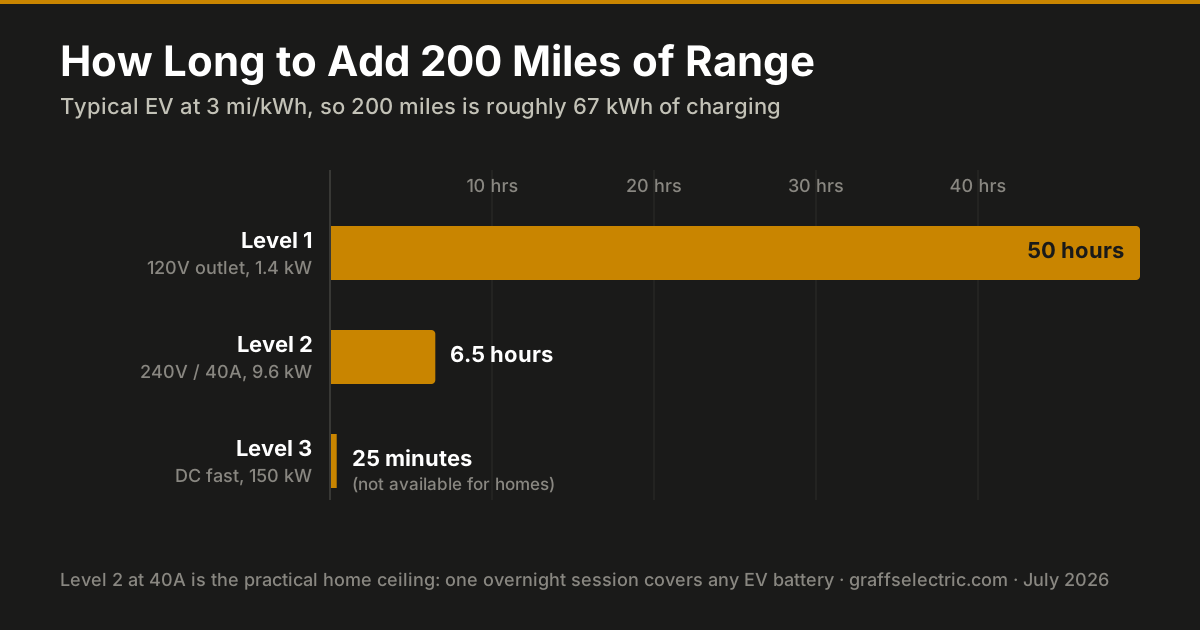
The chart above puts numbers on it. To add 200 miles of range to a typical EV that gets about 3 miles per kilowatt-hour, you are looking at roughly 67 kWh of energy:
- Level 1 (120V outlet): about 50 hours. Two full days.
- Level 2 (240V, 40A): about 6.5 hours. One night, with margin.
- Level 3 (150 kW DC fast): about 25 minutes, once the site exists, which at your house it will not.
Look at the gap between the first two lines rather than the last one. The jump from Level 1 to Level 2 is the one that changes how you live with the car, and it is an ordinary electrical project, not an infrastructure project.
How We Size a Level 2 Install
Amperage is the first decision. A 48-amp hardwired unit is the ceiling for most residential hardware and needs a 60-amp circuit; a 40-amp unit on a 50-amp circuit covers most drivers just as well in practice. Code requires EV charging circuits to be sized at 125 percent of the continuous load, which is where those pairings come from, and it is also why the breaker your charger needs is always bigger than the amps it draws. That “any outlet will do” idea floating around EV forums has burned enough people that we wrote a whole post on the outlet myth; a dryer receptacle on a 30-amp circuit was never designed to run at full load for six continuous hours, and the melted plugs come through our shop to prove it.
The second decision is what your panel can spare. A 60-amp continuous load is a serious addition to a 200-amp service and it is the single most common reason an EV charger quote grows: the load calculation comes back tight and the panel needs work first. If your home still runs on 100-amp service or an older panel, budget for that conversation; our panel upgrade cost guide walks through what that project runs in this area. On the bright side, a panel with room makes the charger install itself pleasantly boring: dedicated circuit, hardwired unit, permit, inspection, done in a day.
As for the charger hardware, we lean toward hardwired units from ChargePoint, Wallbox, and Emporia over plug-in models for anything above 40 amps, both for the code reasons above and because the connection is one less failure point in a device that will cycle heavy load thousands of times. Full pricing for the whole project, including the panel-work scenarios, is in our EV charger installation cost breakdown, but the headline is that most straightforward Bucks County installs land between $900 and $1,800 installed.
The Occasional Exception
Twice now we have had commercial clients ask about DC fast charging where it genuinely made sense: a fleet yard and a retail property near a highway interchange. Those are real projects with real utility coordination, and if that is your situation we are happy to have that conversation. But if the question is about your garage in Doylestown or Levittown, the answer has not changed since the first EV rolled into our service area: a properly sized Level 2 circuit is the fastest charging your house can meaningfully use, and it is the last charging upgrade your daily driving will ever ask for.
If you are weighing it, call us or send a request through the site. We will do the load calculation before anyone talks hardware, because the panel, not the charger, is where the honest answer starts.
Sponsored
Need a Licensed Electrician?
Serving Bucks & Montgomery County. Free estimates on all projects.
Get Your Free EstimateNeed Help With This?
Graff's Electric & IT Solutions is here to help with all your electrical and technology needs in Bucks & Montgomery County.